by Cynthia Bischoff | Jul 17, 2016 | Heartliving
 In certain circumstances, people may depend upon you to provide for them, take care of them, and guide them, and this temporary state of dependency may be normal. Yet if this dependency becomes permanent or occurs over a long period of time, the person may feel angry about needing you. Resentment may grow for both of you. “Why can’t I do this for myself?” may become the person’s question.
If the feelings and dynamics continue, the relationship can turn into a “hostile dependent” one in which the person feels angry for needing you as well as you feeling angry for the dependency.
How is this type of relationship created? You may create a hostile dependent relationship with another person through:
- a need to be needed–if I make the person dependent, I am important;
- a need to control–if the person is dependent on me, I can control their choices;
- a fear of being abandoned–if the person is dependent, he/she won’t leave me.
When you are helping others, ask yourself a few questions to ensure healthy relationship dynamics:
- Would my helping this person give him or her greater independence and growth?
- Would my assistance help this person to know his or her own talents, strengths, and capabilities?
- Does my helping cause this person ultimately to be able to help himself/herself?
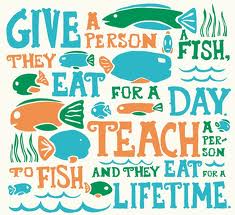
Remember the Chinese proverb: “Give a person a fish and you feed them for a day. Teach a person to fish and you feed them for a lifetime.”
by Cynthia Bischoff | Jul 3, 2016 | Heartliving
 From an evolutionary perspective, fear was meant to alert us about potential danger and to protect us. We may have been afraid of a sound that was heard in the forest in order to alert us to danger or afraid of a cloud formation that might signal a treacherous storm.
In modern times, many of our fears keep us bound and are not helpful in alerting us to danger. Instead, they are formed by a reactionary pattern that keeps us in a less desirable overall state.
We know that our thoughts create our reality. One of the major problems with unconscious fear is that the brain can be in a state of constant anticipation of negative things. We then focus our attention to look for ways to validate these fears. Fear becomes the gatekeeper of our comfort zone and causes us to limit our experiences.
What is helpful is to begin to think and respond differently, to hold a positive outlook.
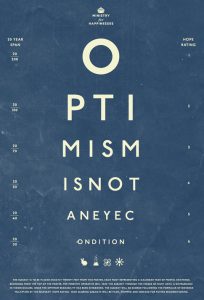
What are some of the benefits of OPTIMISM?
- Based on the Law of Attraction (Like attracts like), by being optimistic, you will draw positive outcomes to yourself.
- Research shows that optimism leads people to better overall health.
- Optimistic people are generally “luckier,” more successful, and regarded as more appealing.
- Studies have shown that imagining positive outcomes releases fear.
- The more optimistic you are, the more you create a pattern of response that perpetuates your positive feelings.
What are some steps to bring about more positive thinking?
- Recognize what is NOT happening in your life that you would LIKE to have happen.
- Identify what you CAN do to make it happen and focus on that.
- Fear and optimism cannot occupy the same space, so the more optimistic you can be and feel, the LESS fear you experience.
- Focus on one thing that makes you happy, that you are grateful for, and bring this into your mind whenever you experience a fearful thought.
You may be surprised that small steps toward optimism can bring about big changes. Combine optimism with gratitude and you are on your way to a better life!
by Cynthia Bischoff | Jun 26, 2016 | Heartliving
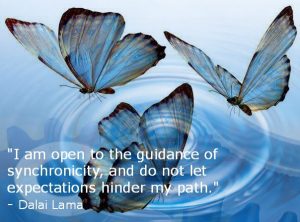 The word “synchronicity” was coined by Carl Jung, famous Swiss Psychiatrist, to mean “meaningfully coincidence.” For example, you need a service and two people mention the same provider, unsolicited, in one day. You’ve been thinking about calling a person and you suddenly see him or her while running errands.
Our lives have a narrative structure, and synchronistic events often reflect turning points and directional arrows in our narrative. They can also indicate that we are in a state of “flow,” and synchronicities have been referred to as the “angel’s way” of speaking with us.
When we are in a challenging place in our lives and without actively seeking support, we may find that help arrives in the form of an accidental sequence of events which occurs exactly as we need in order to assist us in moving through a circumstance or event.
People often report the following synchronicities:
- It is common for telephones, addresses, and wrong numbers to crop up in many stories so that individuals may connect.
- Synchronistic events are almost always present for two people to meet the first time or an important subsequent time.
- It is considered synchronistic when seeming bad luck turns out to have a positive significance.
Sometimes something will delay you, and the delay leads to a more fortunate outcome.
- The more obstinate we become about the way we think something “should” be, the more likely synchronicities will come to speak to us.
- The kind of child we have is always synchronistic–sometimes making parents confront their own shadows, develop their own strengths, and so on.
Most important, if we pay attention to the meaningful coincidences in our lives, we can question their significance. Are they directional messages, are they action-oriented, are they symbolic?
When an extraordinary, meaningful occurrence has significance for us, we should question how we might let it guide or change our story.
by Cynthia Bischoff | Jun 19, 2016 | Heartliving

Do you know the origin of Father’s Day?
In 1910, Sonora Smart Dodd invented her own celebration of Father’s Day to honor her father who was a Civil War veteran—William Jackson Smart. He was a single parent who reared six children in Spokane, Washington, and his birthday was in June. His daughter Sonora felt he should be honored in a dedicated celebration.
In 1913, a bill to create national recognition of the holiday was introduced in Congress. In 1916, President Woodrow Wilson went to Spokane to speak in a Father’s Day celebration and wanted to make it an official holiday. Congress instead resisted the idea, feeling that the day would become commercialized.
President Calvin Coolidge recommended in 1924 that the day be nationally observed, but stopped short of creating a national proclamation.
Finally, Maine Senator Margaret Chase Smith wrote a proposal in 1957 suggesting that Congress was ignoring fathers for over 40 years while honoring mothers. (Mother’s Day was established in 1914.)
In 1966, President Lyndon B. Johnson issued the first presidential proclamation honoring fathers, designating the third Sunday in June as Father’s Day. Six years later, in 1972, President Richard Nixon signed the holiday into law, making it a permanent national holiday.
On this day, take a moment to reflect on your father figure and honor his spirit.
by Cynthia Bischoff | Jun 12, 2016 | Heartliving
 Join my new, restorative workshop, Heal Yourself: Creating Wellness for Your Body, Mind & Soul, on August 13, 2016, from 9:00 a.m. – 5:00 p.m. at the Virginia Beach Resort Hotel & Conference Center on the Chesapeake Bay!
This information-packed one-day seminar will help you learn and apply principles related to healing your body, mind, and soul. Through lecture, discussion, thought and energy exercises, as well as tools to “Heal Yourself,” you will learn how to:
- Identify blockages and clear emotional clutter
- Adopt healthy habits to balance yourself
- Use healing techniques for harmonizing your body, mind, and soul
- Evaluate your “personal soul connection”
- Implement keys to greater health & happiness
- Create the life you want by generating wellness
- Awaken your inner radiance!
Enjoy an Early Bird Special program fee of $150.00 (until July 20th). Regular program fee is $165.00 and conference space is limited so sign-up now to secure your spot. Ready to change your life? Click here to register: REGISTER
by Cynthia Bischoff | Jun 5, 2016 | Heartliving
 Crystals are composed of minerals and are part of the Earth’s energy. Each crystal with its own color, configuration, and properties is believed to hold a different Earth memory and energy.
Throughout history, most religions and cultures have used stones and crystals for both decorative and symbolic purposes. For example, the Celtic people understood that garnet gave a person courage and energy to take appropriate action. Certain Native American tribes placed turquoise on the breastplates of warriors to provide protection. In ancient Babylon and Greece, agate was used as a charm of healing and protection. Amber has been used in ancient cultures as a bringer of courage and honesty.
While wearing jewelry containing crystals and stones is an age-old tradition, more recently it seems as a society we have rediscovered the beauty and power of crystals not only for adornment, but also for assisting in healing the body’s energy.
Stones can be used to stimulate and heal energy in the body. For example, the following stones, among others, are associated with specific purposes:
- To increase your general well-being: clear quartz and zircon;
- To balance your emotions and reduce depression: jade, aventurine, rose quartz;
- To aid in digestion and ease food allergies: citrine, turquoise, agate;
- To ease pain, agitation, and stress: amethyst, sugilite, labradorite.
You can place these stones in your pockets, in the area where you sleep or work, or wear jewelry containing these stones.
By understanding the therapeutic and historical associations of stones and crystals, you can wisely choose stones that can bring both beauty and healing power into your life.