by Cynthia Bischoff | Nov 15, 2014 | Heartliving
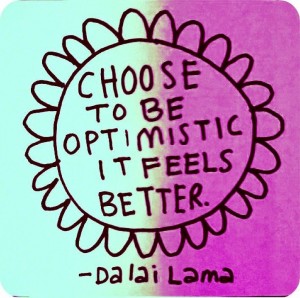 Your thoughts create your reality. One of the major problems with unconscious fear is that the brain can be in a state of constant anticipation of negative things. We then focus our attention to look for ways to validate these fears. From an evolutionary perspective, this act was meant to protect us. Fear is the gatekeeper of our comfort zone.
In modern times, these primitive fears keep us bound and are no longer helpful. What is helpful is to begin to think and respond differently, to hold a positive outlook.
The Benefits of Optimism:
- Research shows that optimism leads people to better overall health.
- Optimistic people are generally “luckier,” more successful, and regarded as more appealing.
- Based on the Law of Attraction (Like attracts like), by being optimistic, you will draw positive outcomes to yourself.
- Studies have shown that imagining positive outcomes releases fear.
The more optimistic you are, the more you create a pattern of response that perpetuates your positive feelings.
Here are some steps to bringing about more positive thinking:
- Recognize what is NOT happening in your life that you would like to have happen.
- Identify what you CAN do to make it happen and focus on that.
- Fear and optimism cannot occupy the same space, so the more optimistic you can be and feel, the less fear you experience.
- Focus on one thing that makes you happy, that you are grateful for, and bring this into your mind whenever you experience a fearful thought.
You may be surprised that small steps toward optimism can bring about big changes.
by Cynthia Bischoff | Oct 25, 2014 | Heartliving
 I grew up in a family of musicians. My father is a musician by hobby and played music constantly in the evenings when I was growing up. He often played the same song all evening until he perfected it. I am fortunate that my father is an excellent musician! I sincerely contribute my ability to “tune out” distractions, but also to drop into deep relaxation easily, as a result of always hearing music in my home.
Music is vibration. We are vibrational, and so is our environment. Often we have stressful days, and it is so helpful to wind down in the evening with music that can shift our moods and relax us.
What are some types of relaxing music? Here are few suggestions:
Harp: The peaceful sounds of the harp can lead you into deep states of relaxation by reducing your stress and tension;
Animal Sounds: Beautiful sounds of dolphins and whales have been recorded on CD’s and have been shown to quiet crying babies. These sounds are deep and low and evoke slow responses in our bodies;
Classical: Certain long, slow, and rhythmic pieces such as those in symphonies are very relaxing. Newer renditions of music by groups such as Enya are very spiritual and calming, moving the emotions;
Flowing Water and Nature Sounds: The rhythms found in nature, such as a flowing river sound or the soft repetition of waves create a relaxing effect;
YOUR Own Favorite Pieces: If you have positive associations with certain songs or artists, these can relax you and also uplift your spirit.
I learned to play guitar when I was 13 and grew up loving Paul Simon, Joni Mitchell, Jackson Browne, Judy Collins, Bob Dylan, The Eagles, Elton John, to name a few, and I still get energized by their music! What are your favorite artists or songs?
by Cynthia Bischoff | Oct 18, 2014 | Heartliving
 Communicating effectively whether at work or at home can improve your relationships and resolve all types of issues.
Being able to listen attentively through effective body language and eye contact is essential. It is likewise helpful to refer to the other person’s actions rather than to their sense of person. For example, if you use “I” statements rather than “you” statements, you are generally more effective. “I feel concerned. . .” is better than “You are doing that wrong.”
Here are some tips for more effective communication:
1. Listen carefully to what others say and refrain from thinking of your own response instead of listening.
2. Seek to resolve problems without being too emotional in your exchange.
3. Write down how you feel if you are emotionally charged and leave it aside for a few hours. Come back to it and re-evaluate your tone before sending any email or letter out.
4. Put yourself in the other person’s shoes in order to better understand the opposing viewpoint.
5. Be able to lighten up and even laugh at yourself in order to lessen tension.
6. Time your exchanges right. Don’t expect a person to listen when he/she is walking out the door.
7. Say you are sorry if you are: Being able to take responsibility for your errors will actually relieve your own stress.
8. Be kind not only to others, but also to yourself. Celebrate your communication successes!
by Cynthia Bischoff | Oct 11, 2014 | Heartliving
 Dreams present you with images and feelings. When you dream, you are often finding answers and solutions to the problems that exist in your waking life. Tapping into and understanding this source of wisdom can enhance your understanding of your life issues.
A dream symbol is an image from the unconscious that is important for you to understand in the present. Symbols can have personal associations, and exploring these associations can help you to understand the dream’s message. It is helpful, though, to understand general objective associations of the dream symbol since it may be revealing.
For example, if you dreamed about a blue horse, you may first remember upon waking that your grandmother had a blue horse figurine that sat on her dresser when you were a child. Yet upon looking further into a dream book, you would see that “horse” reflects “travel, power, and freedom.” The color “blue” may be associated with the throat in energy medicine and may symbolize “speaking your truth.” So why did you dream of a blue horse? Perhaps your grandmother herself is significant to you in her role in your childhood, yet it may reflect a need for you to look at your authentic self–your connection to travel, power, freedom, and truth in your life.
Dream symbols and themes are common among people, and even though each dream may have unique meaning for the dreamer, here are a few “simple” dream meanings based on general dream dictionary ideas:
Teeth (losing teeth or falling out): Loose teeth may relate to changes that are coming and this is considered a common theme in adolescence.
House: The house usually symbolizes the psychological or emotional self. What is the condition of the house in the dream?
Being chased: This may mean that you are being pursued by an aspect of yourself–maybe one that another part of you is avoiding.
Attic: Usually symbolizes your mind or thinking.
Bath: Taking a bath in a dream or attempting to do so may indicate a need for “inner cleansing.”
Vehicle: (What type of vehicle—bicycle, car, airplane?) A vehicle reflects our passage or journey through life. What is our method of transportation? The vehicle may indicate the “speed” of the journey.
Fences: Dreams of fences is said to indicate “boundary” issues: either a need for better boundaries or too much rigidity.
Death: Your own death in a dream reflects new beginnings!
Dreams are magical, and analyzing them is a fascinating process. Using on-line resources for dream interpretation or a good dream dictionary can provide you with insight into the meaning of the dreams, and hence, the meaning of your life!
by Cynthia Bischoff | Oct 4, 2014 | Heartliving
 Are you frequently engaged in a quest for your car keys? Do you fight with your closet to find what to wear? Is stress your daily companion?
An organized life will allow you to have less chaos, more time, and even better mental health!
Why do we become disorganized? First, the creation of physical chaos is a result that originates with your very thoughts. When you are distracted or overly committed, you are less likely to create or have order. You can clear your mind first or clear your clutter. If you are in doubt, start with clearing your closet! It’s amazing what that simple act can do to calm your mind and your life. And that’s just the beginning. . . .
While you may be attached to your clothes (even those you haven’t worn or those that don’t fit any longer), please know that weight and stuff are simply barriers against a world we think is threatening. When you shed the excess you reconnect with your life.
Here are some simple steps to get started:
Step 1: Choose one clothes closet and take everything out of it. If the closet is a walk-in or large, you can do this in stages.
Step 2: Decide the best and most efficient way to hang or store items (this may require some shelves or added pole).
Step 3: When you are set, add each item back one at a time after you have decided that you will KEEP it. In other words, if it doesn’t fit, isn’t the right color, you have two of them, etc., you need to let it go! There are wonderful charities longing for that piece.
Step 4: Decide on ONE type of hanger. Avoid thin wire hangers that are harder to line up or that get tangled with each other. Choose the same plastic style, preferably a thinner type to maximize space.
Step 5: Hang all blouses, all pants, all dresses, all suits—in the same section. This will help you figure out what you really do have, make it easier to find a particular item, and help you maintain order.
Step 6: Make sure that all items are placed facing the same direction. It’s easier to see the front of an item.
Step 7: Hang all colors together in sections if you prefer that method. It’s easier to color coordinate what you are wearing.
Step 8: Shoes and purses can be lined up in order on shelves by color.
Finally, if the closet is large enough or there is any wall space at all that is visible, hang a small framed reminder, like “I am beautiful!” (you and the closet).